

Robot Service Timing: Process CPU Time and Elapsed Wait
2026-11-05
Robot Service Timing: Process CPU Time and Elapsed Wait
Service timing in a robot software appendix needs to identify whether a duration describes CPU work or elapsed waiting. A process can spend time waiting without adding the same amount to a CPU-time counter. Calling both runtime hides the distinction. This article reads Python 3.14 and psutil documentation through a hypothetical service report. It runs no program under observation, samples no process and measures no robot response.
What does Python process_time count?
The official Python 3.14 process_time reference describes the sum of system and user CPU time for the current process. It explicitly excludes elapsed time during sleep and identifies the counter as process-wide. A service summary should preserve those qualifications instead of interpreting the result as the complete duration a user waited for an application.
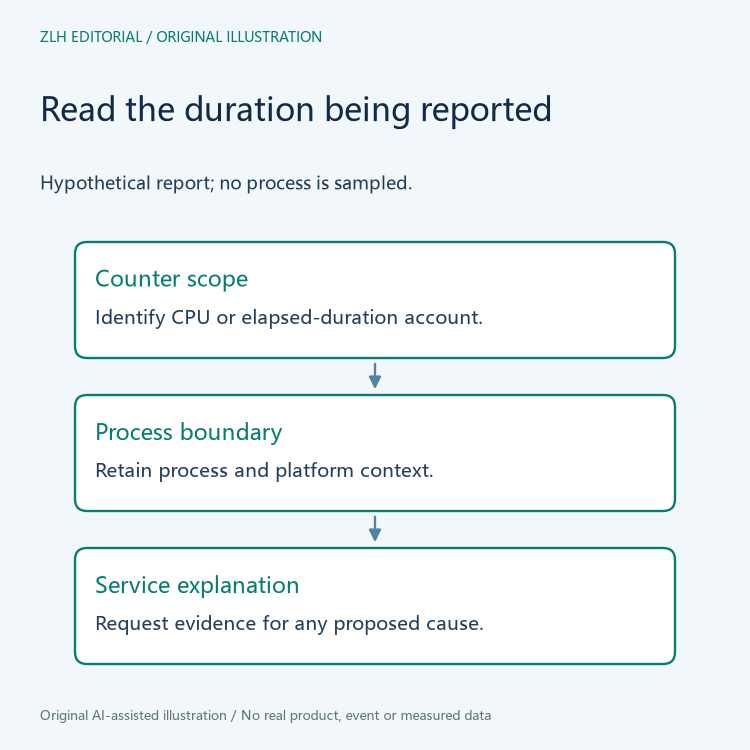
Suppose a hypothetical report calls a recorded difference total task duration while identifying process_time as its source. The reviewer can ask whether the author intended CPU consumption or elapsed duration. That question does not establish that the task was slow or that the reported number was computed incorrectly. It identifies a mismatch between a broad label and the counter's documented scope.
The Python reference also says the counter's reference point is undefined, so differences between calls are meaningful rather than its value being an ordinary date. A service record should not turn the counter into a calendar timestamp. Retain the actual start/end observation account if it was supplied. This article provides no invented readings and performs no duration calculation.
How does psutil separate process CPU fields?
The official psutil Process.cpu_times reference describes accumulated process times in seconds, including user-mode and system-mode time. It separately describes child-process fields and, on Linux, an I/O-wait field excluded from user and system counts. Keep the named fields and platform notes attached to any total a contributor reports.
A hypothetical appendix might add every visible field and call the result one process's active CPU time. Before accepting that label, ask which fields were included and why. The documented separation is a reason to preserve the calculation account, not an instruction to perform a particular sum. This article has collected no process counters or inspected the implementation of an actual support tool.
Can low CPU time explain a long wait by itself?
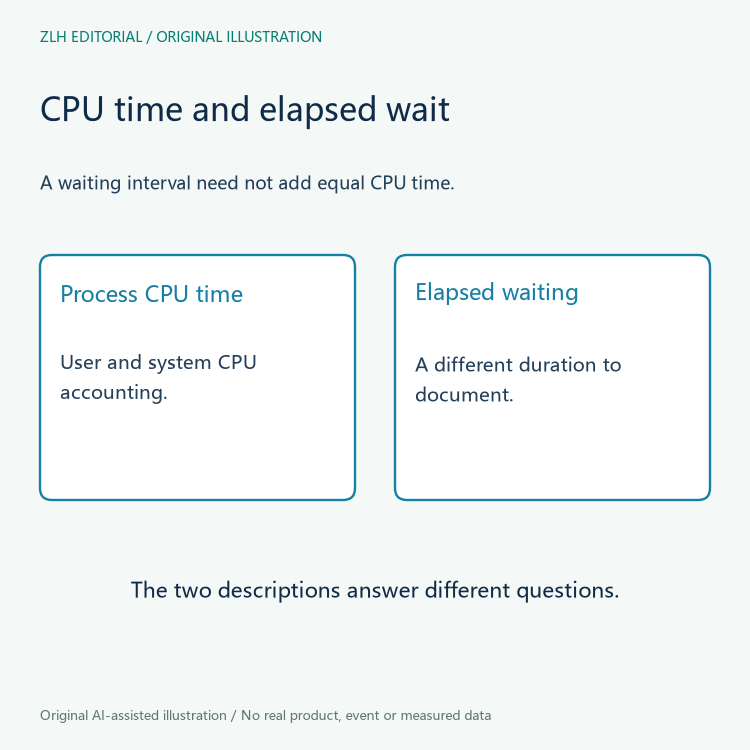
CPU time and elapsed waiting answer different questions, so a difference between them is not automatically a contradiction. The source definitions establish their accounting scope. They do not identify the reason for a particular application's wait. An actual explanation may require additional traces and an understanding of the workload, which the hypothetical packet has not supplied.
Suppose a contributor reports that a robot-related application waited while its CPU counter changed little. A reviewer can preserve that observation as claimed, then ask what evidence connects it to a proposed cause. The counter alone does not establish a network fault, blocked device, storage issue or hardware defect. Listing possible questions is different from diagnosing which event occurred.
Keep process identity in the account. The current process, another named process and a set of child processes are different observation scopes. A duration should not silently move between them during summarization. If a contributor changes the collection tool, ask whether the new tool observes the same process boundary and counter definitions before comparing the reports as one series.
Likewise, a process-wide counter is not automatically one function's exclusive cost. A function-level claim needs its own collection scope and explanation of other activity. A support reviewer can identify that missing relationship without profiling the program. This article does not measure function latency, scheduling delay or total workload throughput.
What should a timing clarification preserve?
A bounded clarification records the tool, operating-system context, process scope, counter fields and claimed observation interval. It labels CPU accounting separately from elapsed duration. If a total was derived, retain the contributor's formula and input fields as a described calculation. The actual output remains evidence supplied by that contributor, rather than something inferred from a documentation example.
If the author corrects runtime to process CPU time, preserve that terminology revision. It may explain the same original value without describing any new application behaviour. If new observations were also collected, identify them separately. This prevents a corrected caption from being reported as an application performance improvement or a successful repair.
The Python source is versioned to 3.14, while the psutil reference has its own version and platform scope. A similar name in another tool does not remove the need to read its definition. These references explain accounting concepts; they do not show that a submitted tool implements every counter exactly as a reader expects.
Both original figures contain no timestamps, CPU values or observed delays. Related material appears in the robot software-service category and related resource category. Precise service timing keeps CPU work and elapsed waiting separately named, so the next support question concerns the actual evidence rather than an ambiguous runtime label.


