

Robot Repair Logs: Snapshot Buffer and Written Bag
2026-11-05
Robot Repair Logs: Snapshot Buffer and Written Bag
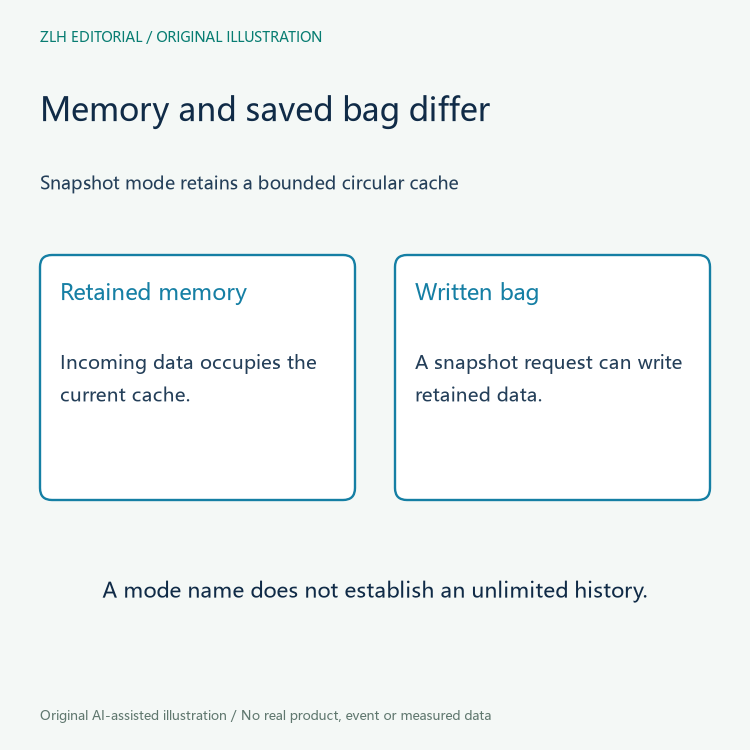
Snapshot recording can be useful vocabulary in a robot repair file, but the word snapshot does not identify an unlimited history of the machine. In rosbag2, the documented mode concerns a retained memory buffer and a request that can write its contents to disk. Those are different objects. A service reviewer should establish which saved artifact has actually been supplied before describing the incident evidence. This article reads public documentation; it does not connect to a recorder, invoke a service or operate a robot.
Begin with the documented recorder mode
The official rosbag2 Jazzy README describes snapshot mode as keeping incoming messages in an in-memory circular buffer instead of writing them to disk as they arrive. A request can dump the retained buffer to disk. The configuration therefore matters to an account of how a bag was obtained. Simply calling every recording a continuous log would conceal the distinction the documentation makes.
For an existing repair submission, ask which recorder mode the supplier says was in use and which records support that account. Keep the response alongside the saved bag's identity. A reference to a supported feature is useful background, but it does not establish that a particular recorder used it during the event. This article provides no commands or settings for enabling the mode on a live system.
Describe the cache as a bounded retained object
The README explains the snapshot buffer in terms of its configured size and the last retained bytes of incoming data. That is a bounded retention mechanism. It should not be rewritten as everything that has ever happened since startup. Nor should a writer convert the feature description into a fixed number of minutes for an unknown recording. The available time span depends on the actual recording circumstances and needs its own evidence.
Consider a fictional repair email that says snapshot enabled and concludes that the entire preceding shift is available. Without the saved recording and a supported account of its span, the conclusion goes beyond the mode description. The useful correction is to request the identified artifact and clarify the retained interval. This example concerns no real incident, machine or measured data rate. It illustrates why a retention feature cannot supply a missing history by name alone.
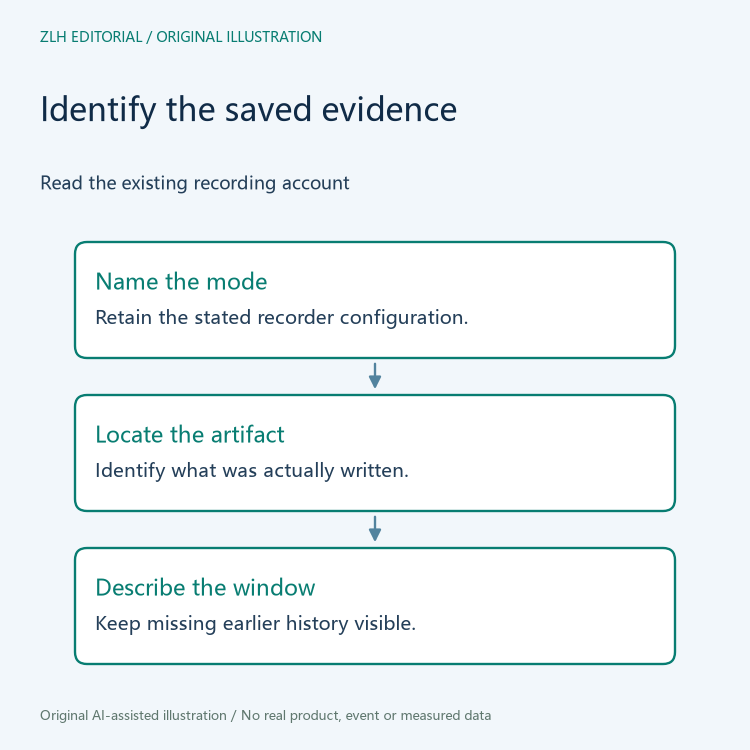
Separate a snapshot request from the received artifact
The same README identifies a recorder snapshot service for this mode. The official Jazzy Snapshot service definition has an empty request and a boolean success response. That small interface definition does not contain a list of incident events or a description of the saved bag's entire contents. An interpretation of an actual response must stay separate from an interpretation of an actual file.
A repair note can therefore preserve several distinct statements: the supplier reports that snapshot mode was configured; an existing service response is available; and a named bag was delivered. Do not silently turn one of these statements into the others. If the file is missing, record that absence as a limitation of the submission rather than claiming that the incident never occurred or that the machine failed to publish information.
Keep the incident timeline outside an unsupported reconstruction
A circular cache can explain why a saved snapshot represents retained data around a selected point of interest. It does not by itself explain every gap between a person's observation and the file's contents. Preserve the original incident account, the recording account and the saved artifact as related materials. If their timelines need reconciliation, identify the specific missing relationship instead of inventing a cause.
For example, a fictional intake might contain an observation described as earlier, but no clear association with the supplied bag's interval. The reviewer can request the basis for that association. A statement that the bag does not establish the earlier event is narrower than a statement that the event did not happen. This is a document-reading boundary, not a diagnosis of the recorder or robot.
Close the reading with an identifiable evidence window
The sources used here are from the rosbag2 Jazzy branch, read on November 5, 2026. Keep the applicable project version in a real repair file, because a general branch reference does not identify an installed recorder. A useful closing note names the received bag, explains the reported retention mechanism and states which earlier context remains unsupported. That gives the responsible service team a concrete next question.
The illustrations are original conceptual aids, with no real log values, timestamps or product likeness. This article does not assess the completeness of a particular recording or offer a recovery procedure. Further material is available in the robot repair evidence collection and article directory. A precise Snapshot account keeps retained memory, a written bag and the incident explanation connected without replacing one with another.


