

Robot Service Portal Maintenance: Read Redirect History
2026-11-04
Robot Service Portal Maintenance: Read Redirect History
Redirect history explains a sequence of HTTP responses on the way to a final destination. A robot service portal maintenance note that shows only the last response may leave out the route that led there. The sequence is useful for understanding a link or page retrieval, but it does not prove that a repair request was created. This article uses fictional, read-only documentation and does not contact a service portal or submit personal information.
Name the request being described
Imagine a fictional report stating that a support address returned a successful page. Before drawing a conclusion, the reviewer should ask which initial URL and request method the report concerns. A retrieval of public guidance and an actual submission are different tasks. The maintenance record must identify its object instead of allowing a successful guidance-page response to stand in for evidence of an accepted service request.
Retain the supplied initial address, method, observation time and tool settings. If the provider gives only a final screenshot, describe only what that screenshot supports. Do not invent an intermediate redirect because one seems likely, or assume the route was direct because the browser displayed a familiar destination. The purpose is to preserve the sequence actually reported, not reconstruct an unobserved network exchange.
Read the library's history property at its own scope
The official Requests quickstart documents location redirection and the Response.history list, ordered from older to more recent responses in the redirect sequence. It distinguishes the final response from that history and describes settings that affect redirect handling. This is library behaviour, not a result from the fictional portal or a universal description of every client.
For the fictional report, ask whether the provider enabled automatic following and which responses it retained. The method and settings belong with the output. An empty history needs its own context; it should not automatically be rewritten as proof that no redirection was possible. Likewise, a final response code should be associated with the final response object rather than copied onto every step of the reported route.
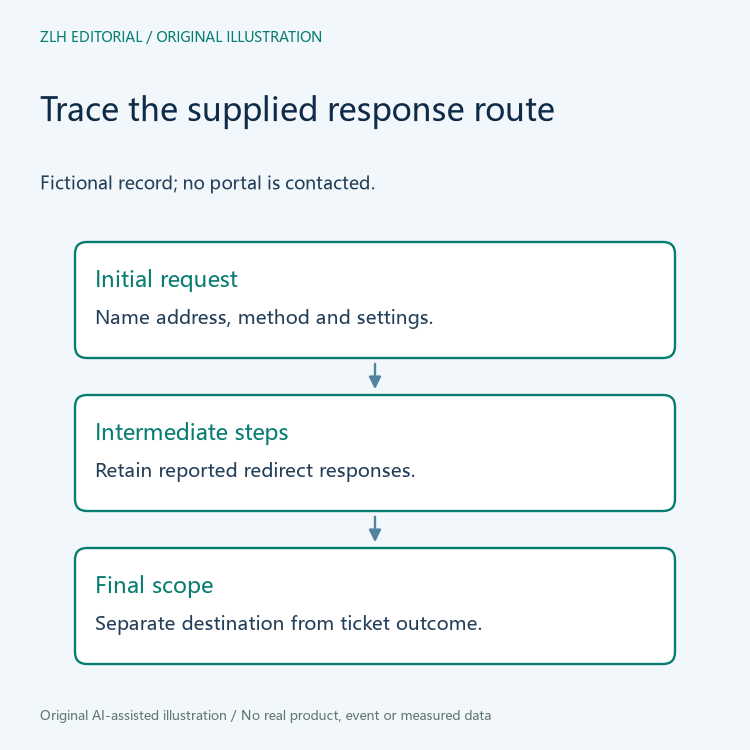
Read HTTP redirection without inventing its business meaning
RFC 9110's redirection section defines the HTTP redirection status class and describes its individual codes. The meaning of a particular redirect depends on that code and the response context. A provider should preserve the actual status and relevant destination information, rather than using one generic word to imply that every intermediate response has the same semantics.
The fictional maintenance note can identify each supplied step and the final destination without declaring why the site operator configured the route. A redirect might be part of a documented design, but the reason needs supporting material. Do not treat it as proof of a portal failure, a new service provider or a changed ticket owner solely because the address shown at the end differs from the starting address.
Keep retrieval evidence separate from service evidence
A final page can be useful to a person seeking guidance while still saying nothing about a particular ticket. If the fictional task was to review a help link, keep the conclusion at that task. Evidence of a submitted request needs the appropriate application record and context. This article has no submission or ticket record, so it makes no statement about whether a service request exists or was processed.
If a provider later supplies application evidence, connect it to the correct task and version rather than replacing the earlier retrieval note. Both records may remain useful, but they answer different questions. A route observation should not acquire a broader business meaning merely because it appears near a ticket label in a maintenance pack or because the final page contains a general success message.
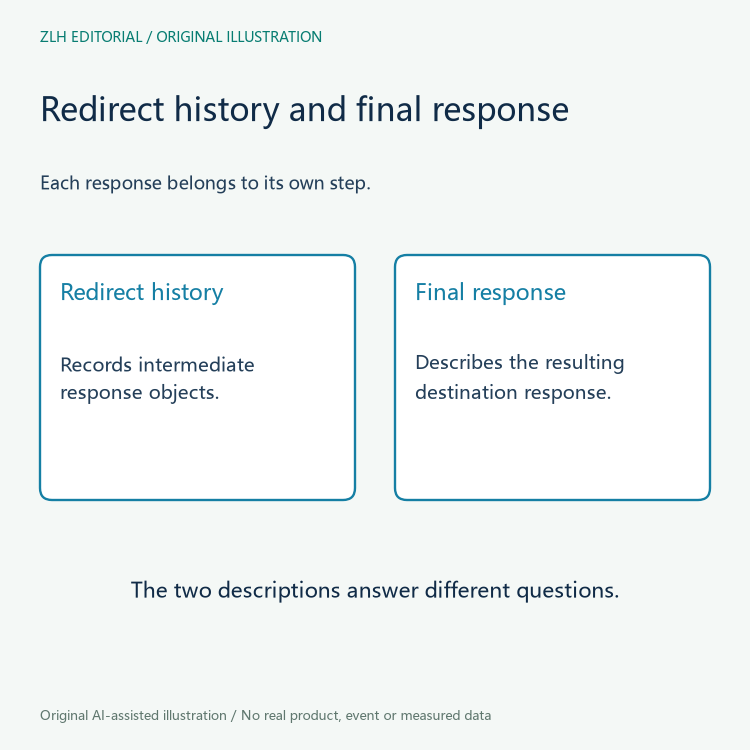
Write a route-aware maintenance finding
A useful finding names the initial request, client settings, supplied intermediate responses and final destination. It should identify missing parts of the record explicitly. If another review uses a different method or client, retain that difference rather than assuming the routes are directly comparable. This makes the maintenance history readable and gives the next reviewer a concrete object to investigate.
Preserve the provider's explanation separately from the network facts it reports. If the route was said to change during a site revision, identify the supporting revision material. The reviewer should not infer an organisational or operational change from an address alone, especially where the actual observation was only a read-only guidance retrieval.
Additional methods appear in the technical material category and related resource category. These category entrances do not process requests. Keeping redirect sequence, final response and application outcome distinct lets the next service conversation begin with the evidence actually supplied.


