

Robot Service Disclosure: Review What Open Actually Means
2026-11-04
Robot Service Disclosure: Review What Open Actually Means
A service disclosure control can show or hide supporting information in a robot repair portal. When its help panel is open, that describes a presentation state. It does not establish that a ticket has been opened, accepted or resolved. A portal handover should name the object behind each use of open. This article discusses a fictional interface and documentation review; it does not submit a repair request or test a real portal.
Separate the help panel from the service record
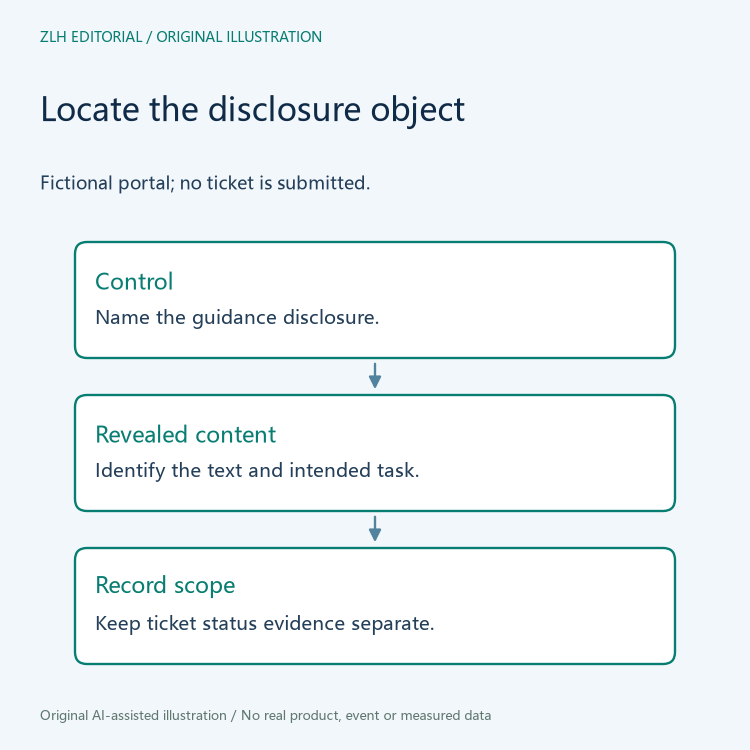
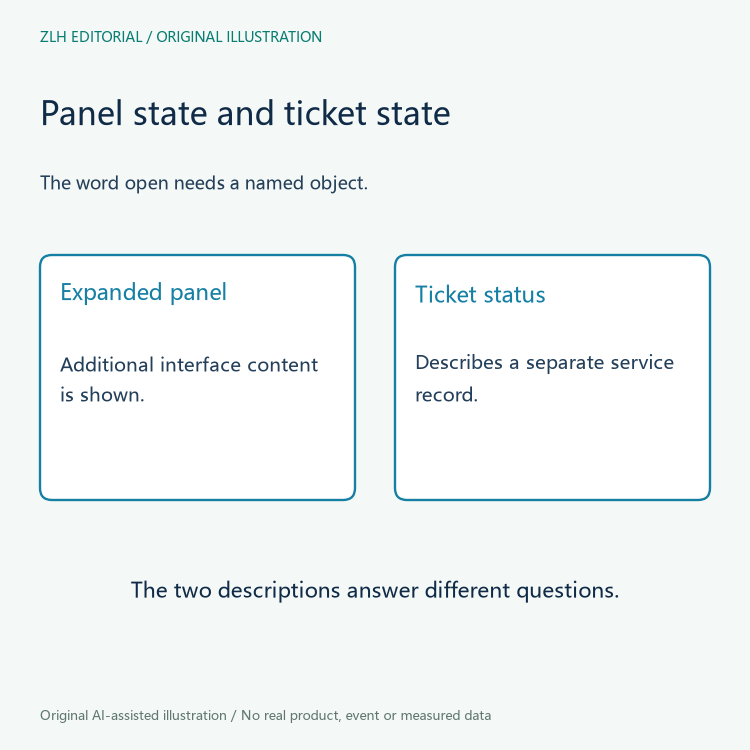
Imagine a fictional intake page with a section labelled Attachment guidance. Activating its heading reveals explanatory paragraphs. Elsewhere on the page, a ticket label also contains the word open. These are different objects: one concerns the visibility of guidance, while the other purports to describe a business record. A handover screenshot should not merge them into a single status statement.
Ask the provider to identify the guidance control, the content it reveals and the record status display. A small diagram can be helpful if it names those elements clearly. The reviewer still needs the accompanying explanation. An arrow pointing downward might suggest expanded content, but it cannot by itself explain whether a ticket exists or what work a service team has undertaken.
Read the native details element as a disclosure
The WHATWG HTML Standard describes details as a disclosure widget that provides additional information or controls. Its first summary child supplies the summary or legend. The boolean open attribute indicates whether the additional information is shown. These definitions concern the document interface, not the condition of equipment or the stage of a repair.
For the fictional handover, a source excerpt could establish that the provider intends a native disclosure. That does not show how every browser and assistive technology behaves in the delivered project. Keep the source description separate from any later interaction observation. A static screenshot may establish that text was visible when captured, while leaving the control's operation and other states unexamined.
Read custom disclosure semantics at the same scope
The W3C Authoring Practices disclosure pattern describes a button controlling a section's visibility. Its expanded state communicates whether that content is shown, and its keyboard interaction describes toggling the disclosure. This is pattern guidance, not a certification that a particular portal is accessible. The provider must identify the actual implementation before a reviewer applies the explanation to it.
A custom control may be documented differently from native details. Do not assume every arrow icon is the same widget or recommend additional attributes without considering what the project uses. The acceptance record can ask for the intended control type and state explanation. Any testing must then report its own environment and observations, rather than copying a pattern's expected behaviour into a results column.
Keep revealed instructions available as actual content
In the fictional portal, the disclosure might contain an attachment naming convention. The review should identify the text supplied, its version and the task it supports. Merely proving that a panel expands would not establish that its instructions are complete or suitable. Conversely, an instruction document does not establish that a user can operate the delivered control. Content and interaction need related but distinct evidence.
If several panels can affect one another's visibility, ask the provider to explain the intended arrangement. A reader comparing instructions may need to understand whether opening another panel changes what remains visible. This article offers no usability result for such an arrangement. It proposes a concrete handover question so that the documentation reflects the interface people are expected to encounter.
Use object names in the final acceptance description
Keep the panel heading in the record as well as its general purpose. If a later revision renames the heading, the relationship to earlier instructions should remain understandable. Otherwise a help document may tell readers to expand a control they cannot locate, even though the underlying guidance text has survived unchanged. This is a documentation maintenance question that can be identified without inventing a user test.
A clear finding could say that the attachment guidance panel is documented as expanded in the supplied view, while ticket status evidence is handled separately. Avoid the ambiguous statement that the service is open when only guidance visibility was examined. If no interaction review has occurred, retain that limit explicitly. Documentation acceptance should make the next review easier, without implying a repair outcome.
Related reading is organised in the technical material category and related resource category. Those categories do not process tickets. Naming the disclosure, its revealed content and the service record independently helps the handover reader understand what each state describes and prevents an interface detail from becoming an unsupported claim about actual service work.


