

Service Form Acceptance: Keep Required Instructions Visible
2026-11-02
Service Form Acceptance: Keep Required Instructions Visible
Required instructions in a robot-service form should remain understandable while a person enters the requested information. A hint inside an empty field can be useful, but it may disappear just when the person needs to check the response. Before accepting an intake-page delivery, a buyer should examine what the instructions promise and what the form actually presents. This proposed review submits no real service request and uses no customer details.
Define the intake task and the information it requires
Ask the service owner which information is essential for the agreed intake task and why. An implementation label should not decide that policy by accident. The responsible team needs to distinguish information needed to understand the request from optional supporting context.
The receiving reviewer should identify the actual page revision and the field under discussion. A design screenshot can show intended wording without demonstrating the behavior of the delivered form. Keep the design proposal and implementation observation as separate records.
For the fictional review, prepare questions rather than inventing a repair ticket. Ask where the user can find the instruction before entering text, while entering it, and when checking the completed response. These stages make the intended task concrete without collecting personal information or pretending that a real customer completed it.
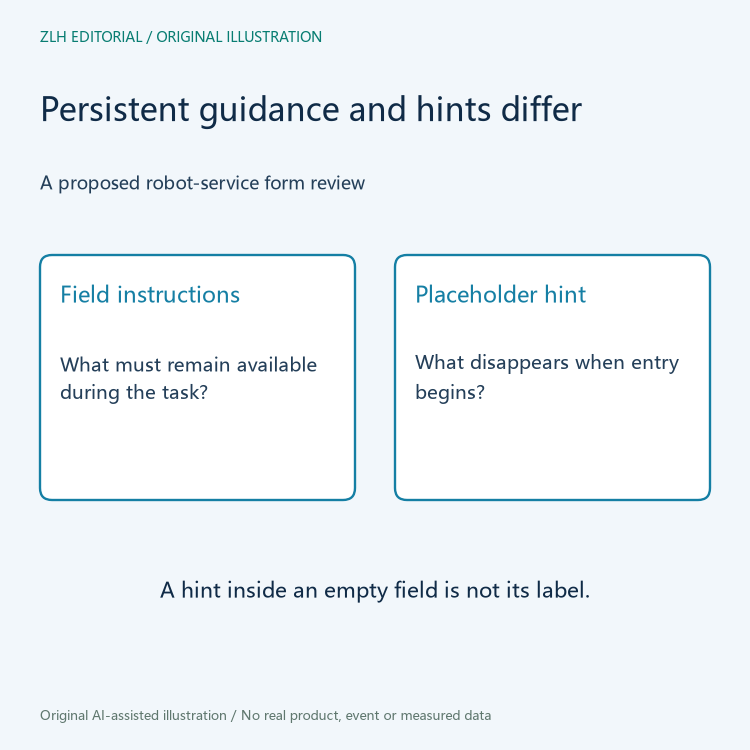
Do not rely on a disappearing hint for persistent guidance
The W3C WAI form instructions tutorial explains that placeholder text disappears as users enter information and is not a replacement for labels. If a required format or instruction exists only in that hint, the reviewer should ask how the person can consult it again while checking the response.
A supplier should identify which wording labels the field and which wording provides additional instructions. Those functions can be related without being interchangeable. A buyer should not accept a screenshot of an empty input as evidence that the instruction remains available throughout the task.
This does not mean every field needs a lengthy paragraph. The service owner should provide the information the task actually requires in an understandable location. The acceptance question concerns the relationship between the instruction, the field, and the user’s activity rather than an arbitrary word count.
Separate required-field behavior from the service policy
MDN’s required attribute reference describes the applicable constraint-validation behavior when a required field has an empty value. It also discusses visible indications and attribute interactions. These details belong to the implementation context, not to a general promise that every kind of field behaves identically.
Ask the supplier which applicable controls use that behavior and how required information is communicated to users. A colored mark alone should not be treated as the entire explanation. Likewise, merely placing the word required in a design note does not show what the delivered form exposes.
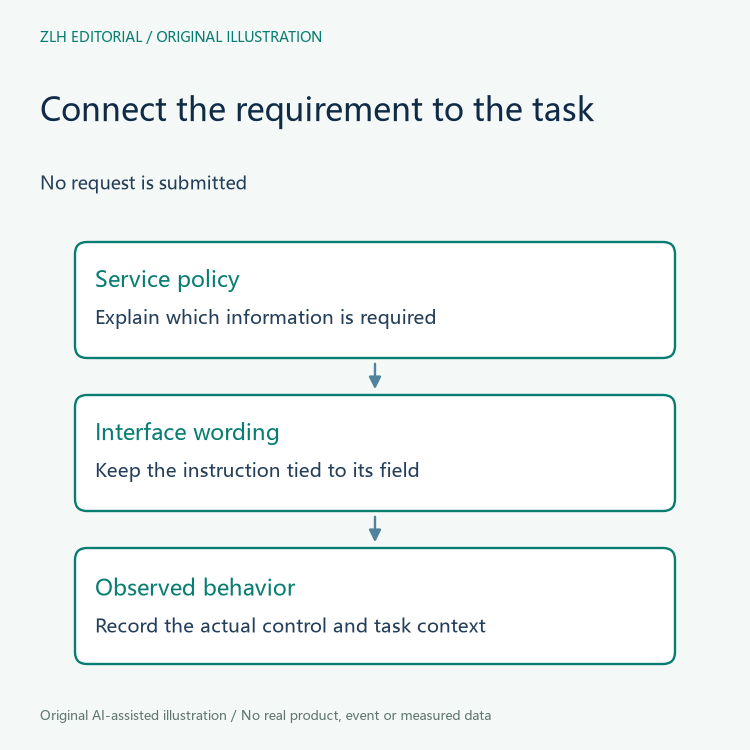
The present article tests no browser and supplies no validation result. A later authorized exercise should record the control type, page revision, input condition, and actual response. It should not infer server-side processing or service acceptance from one client-side indication.
Review instructions while the response is being checked
A proposed acceptance exercise should consider the point at which a person reviews entered information. Can the person still identify the expected content and any relevant format? If the only explanation vanished with the first character, request a clearer presentation rather than ask the reviewer to remember it.
If the form owner changes which information is mandatory, ask whether the visible wording and implementation remain aligned. The policy and interface can drift independently. An old screenshot should not automatically be reused as evidence about a revised intake requirement.
Keep scope clear when recording observations. Checking persistent instructions does not establish complete accessibility, security, response time, or repair competence. Those are different matters. The buyer should name the review performed and retain any remaining questions for the responsible owner.
Accept a usable explanation rather than a decorative marker
The handover should connect the required information, its visible instruction, the applicable control behavior, and actual task observations. It should make unresolved cases visible, including fields whose purpose or mandatory status remains unclear. That gives the supplier a focused correction request.
Ask who will maintain the wording when the service intake changes. A useful acceptance record includes responsibility for the instruction as well as the implementation. Otherwise a technically unchanged form may keep obsolete guidance after the service team revises its process.
Further notes appear in our robot service intake section and the article directory. Both original illustrations contain no submitted form, customer data, ticket identifier, observed validation failure, or completed service activity.


