

Service Portal Practice: Status Feedback Without Moving Focus
2026-11-02
Service Portal Practice: Status Feedback Without Moving Focus
Status feedback helps a service requester understand whether a web form is waiting, processing, or reporting an outcome. A visible message and a change of keyboard focus are different mechanisms. This practical article proposes a review of an instructor-prepared service form. It does not submit a real repair request or test a live portal. The task is to explain how a short feedback message relates to the action the requester was performing.
Choose one action and describe its feedback needs
Begin with an imaginary attachment-selection step. Separate selecting a file, beginning an upload, and receiving confirmation about that upload. These activities need different explanations. A message about selection should not imply that a server has stored the attachment, and a waiting message should not imply that a service case has been accepted.
Write the intended meaning before choosing interface text. Ask what the requester must know at this point and what remains undecided. This keeps the review connected to the actual task rather than to a generic success banner. The fictional example contains no real file, customer information, or case identifier.
Keep the prepared form unchanged during the initial reading. Identify where focus would be before the update and what information would appear elsewhere. The reviewer needs both pieces to discuss whether an update could be missed while the requester continues working.
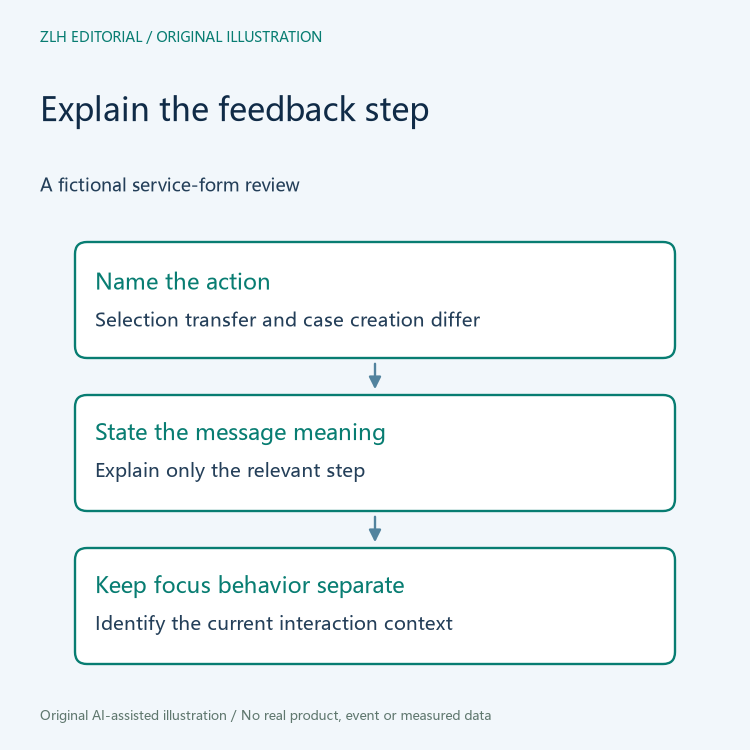
Distinguish a status update from a new context
The WCAG explanation of status messages discusses qualifying content changes that can be programmatically determined without receiving focus. It also explains the boundaries of the status-message definition. Not every new item on a page is automatically a status message.
Use that distinction to classify the fictional update before selecting a technique. A brief explanation that a prepared process is waiting may have a different role from a dialog requiring a decision. The reviewer should state why the particular message belongs to the task, rather than applying the same announcement mechanism to every page change.
A page can display useful information without moving the requester away from the current control. Conversely, a separate interaction may require its own focus design. This article does not decide every focus question through the status role. The proposed review keeps those decisions explicit and tied to the prepared interaction.
Read the role before assuming how the update is conveyed
The WAI-ARIA definition of status specifies implicit polite live-region behavior and an implicit atomic value of true. These are semantics of the role. Merely drawing a colored box or naming a CSS class status does not establish that those semantics are present.
For a later authorized implementation review, identify the actual element carrying the message and the semantics provided to accessibility software. Keep the message wording beside that observation. The reviewer should not infer programmatic behavior from a screenshot or from an attractive animation alone.

This proposed exercise supplies no assistive-technology test results. If a class later examines an implementation, it should record the browser and assistive context actually used. Documentation about role semantics cannot substitute for observing that implementation in its stated environment.
Check that the words identify the completed step
Read the hypothetical feedback with the surrounding form hidden. Can another reader tell which action it concerns? A bare completion word can be ambiguous when selection, transfer, and case creation are separate operations. The prepared message should identify the relevant step without claiming a broader service outcome.
Next, return the surrounding form and ask whether repeated or changing messages would be understandable. A reviewer can propose clearer wording without claiming that the portal has been fixed. Keep editorial suggestions separate from observations about an implementation that has actually been examined.
Do not fill the demonstration with invented successful uploads. A conceptual exercise can describe the questions to ask while leaving outcomes unobserved. This makes the article useful for planning a review without turning the plan into evidence of a functioning service system.
Finish with two separate review questions
Ask whether the requester can understand the action’s status and whether focus behavior fits the interaction. Answering one question does not automatically answer the other. If the prepared material lacks enough information, record the missing context rather than guess what a screen reader would announce.
A useful exercise summary identifies the action, the feedback meaning, the relevant semantic role, and the focus question that remains. It does not certify an entire site or make a promise about repair service. Broader evaluation would require a defined scope and actual observations.
Related discussion appears in our service-intake practice section and the article directory. The two original illustrations are conceptual teaching aids, with no real upload, portal screenshot, user study, or accessibility test result.


