

Robot Service Intake Maintenance: Explain a Rejected File
2026-11-01
Robot Service Intake Maintenance: Explain a Rejected File
A service intake form lets a person select an attachment, then reports that the file cannot be accepted. The maintenance question is whether the selection guidance, receiving rules and user feedback describe the same workflow. It is not evidence that a robot has failed or that a customer's document is unsafe. This fictional case uses no real attachment, personal information or submission to a service provider.
Selection and acceptance need separate observations
The first note should identify the page, the intended attachment and what the user actually saw at each stage. A file appearing in a picker is one observation. Its name appearing next to a control is another. A confirmed acceptance by the receiving service would require its own evidence. Do not combine all three into a single statement that the attachment uploaded successfully.
Imagine that the reporter supplies a screen capture of a selected filename followed by a generic rejection message. Retain those observations without publishing the filename if it contains private information. If no actual file or authorized technical report is available, say that the file's contents and format have not been examined. A visible suffix cannot fill that evidence gap.
The picker can guide without proving acceptance
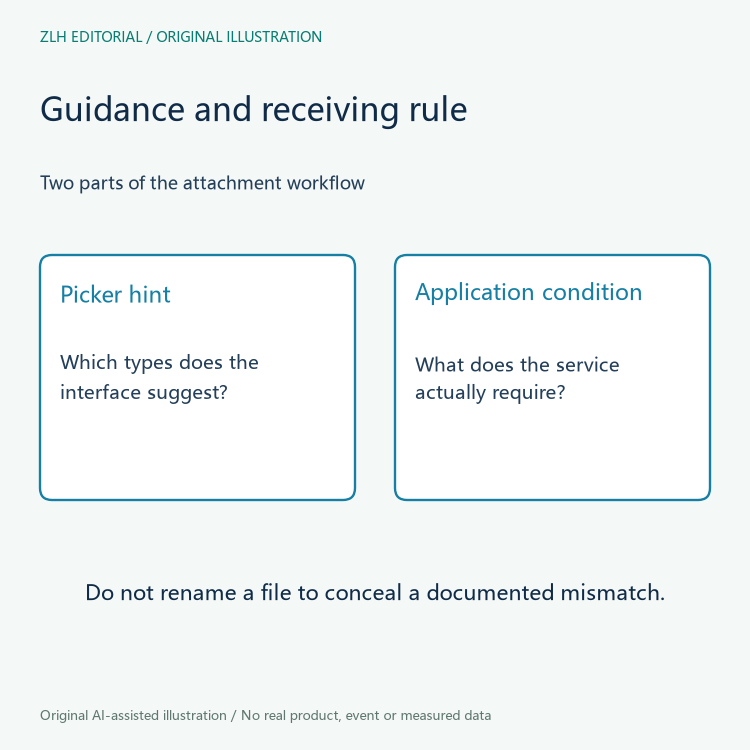
The HTML file input description defines accept as a hint about the types a user agent should offer. That gives a maintainer a precise distinction between selection guidance and the receiving application's rules. It does not establish which hints the fictional form supplied or whether its server accepted the selected object.
Ask the responsible team to identify the actual guidance presented in the affected page revision and the documented acceptance conditions. Keep those statements associated with the report. A generic browser example should not be copied into the incident history as the portal's implementation. Likewise, the ability to choose a file should not be treated as an assurance that its contents meet the service's requirements.

Where the guidance and receiving rule differ, the owner can decide how to reconcile them. That decision needs to respect the intended support workflow and the permitted material. The coordinator should not rename a file, change its contents or relax acceptance controls merely to make a demonstration succeed. Such actions could hide the original mismatch instead of explaining it.
A useful error identifies the affected item
W3C's Error Identification explanation discusses identifying automatically detected input errors and describing them in text. This supports a concrete interface-maintenance question: can the user tell which input caused the problem? It is not a diagnosis of the attachment and does not certify the entire service form as accessible.
For the imagined report, preserve the actual feedback wording and the point at which it appeared. If several inputs are present, do not assume that a general warning refers to the attachment. The responsible team can clarify the relationship using authorized evidence. A support note should not attribute a rejection to file size, media type or a damaged document without that clarification.
A proposed improvement may concern wording rather than the acceptance rule itself. Record the distinction. If the application correctly enforces a documented condition but fails to explain it, a clearer message can address a real usability concern. That does not require describing the accepted material as broader than the service actually permits.
Keep any revised delivery connected to the original question
Suppose the reporter is authorized to provide another attachment through the normal channel. Treat it as a new delivery and identify its relationship to the earlier one. Acceptance of a replacement can restore the person's ability to continue while leaving the original file's rejection unexplained. Do not erase that limitation or call it a recovered attachment.
If a technical change is made, its record should state what changed and why. A modified hint, a revised message and a different receiving rule are different actions. The handover needs to distinguish them so that later staff understand whether the original problem concerned guidance, interpretation or an implementation mismatch.
Recheck the workflow under a defined scope
An actual authorized recheck can use permitted demonstration material and record the selected input, observed response and next available action. Keep its conditions with the result. Checking one attachment does not establish that every format, device or historical report is covered. No such recheck has occurred in this article, and no acceptance rate is supplied.
The original illustrations depict stages of an information workflow without real files or customer records. Related reading is available in the robot service intake section and the article directory. A maintenance note that separates picker guidance, receiving rules and clear feedback helps the service team act on the actual concern without inventing an attachment fault.


